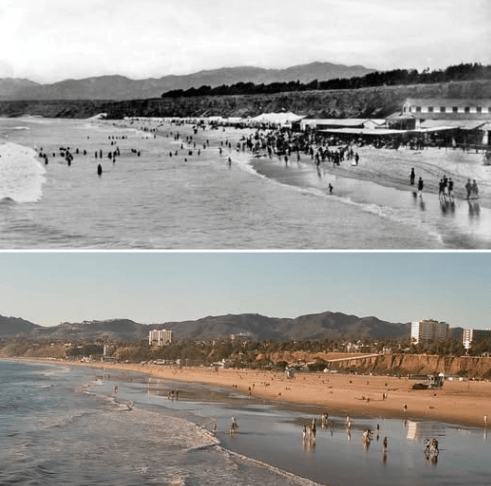
If you look at archival photographs of the Santa Monica coastline from fifty years ago compared to today, you will notice a fascinating and continuous transformation. Famous for its sweeping sandy beaches, iconic pier, and bustling coastal boardwalk, Santa Monica has spent the last half-century locked in a dynamic relationship with the Pacific Ocean. But this transformation is more than just a local urban development story—it serves as a powerful window into global environmental change.
At Avoid 3, our core mission is to empower underprivileged youth by making climate education accessible, engaging, and directly relevant to their daily lives. By exploring how familiar landscapes like the Santa Monica coastline have evolved, we help students connect abstract global climate discussions to tangible, real-world changes happening right along our shores.
Half a Century of Human and Natural Shifts
Fifty years ago, the Santa Monica coastline faced intense pressures from heavy coastal erosion, urban runoff, and expanding infrastructure. To protect coastal highways, parking structures, and recreational spaces from severe wave battering, city planners and engineers initiated major coastal stabilization projects. These efforts included constructing breakwaters, implementing strict zoning, and executing massive beach nourishment programs—pumping millions of cubic yards of sand onto the shore to artificially widen the beach.
While these engineering interventions successfully stabilized local shores for decades, they also revealed a hard truth: natural coastal ecosystems are increasingly vulnerable to human-induced pressures and shifting ocean dynamics.
The Modern Challenge: Sea-Level Rise and Climate Urgency
Today, the coastal evolution of Santa Monica is driven by an even greater force—accelerating sea-level rise caused by global warming. As polar ice melts and thermal expansion warms the oceans, urban coastal regions worldwide face heightened risks of severe storm surges, habitat loss, and property destruction.
This is precisely why our platform emphasizes avoiding a 3°C warmer future. A three-degree global temperature increase would unleash catastrophic sea-level rise, rendering many coastal cities and island communities uninhabitable and displacing millions of people. Studying how coastlines adapt today gives students a front-row seat to why aggressive carbon reduction and local resilience planning are urgently needed.
Turning Local Observation Into Global Action
Environmental education should never feel distant or academic. By examining local geography, coastal management, and climate adaptation projects, young people learn that climate change is not a futuristic concept—it is happening right in our backyards.
Knowledge is the foundational step toward real change. When young minds are equipped with the right tools, science literacy, and historical context, they transition from passive observers into active changemakers ready to protect their communities.
Want to bring engaging, real-world climate education to your students or community? Explore our programs or contact us today to join the Avoid 3 movement!


Leave a Reply